

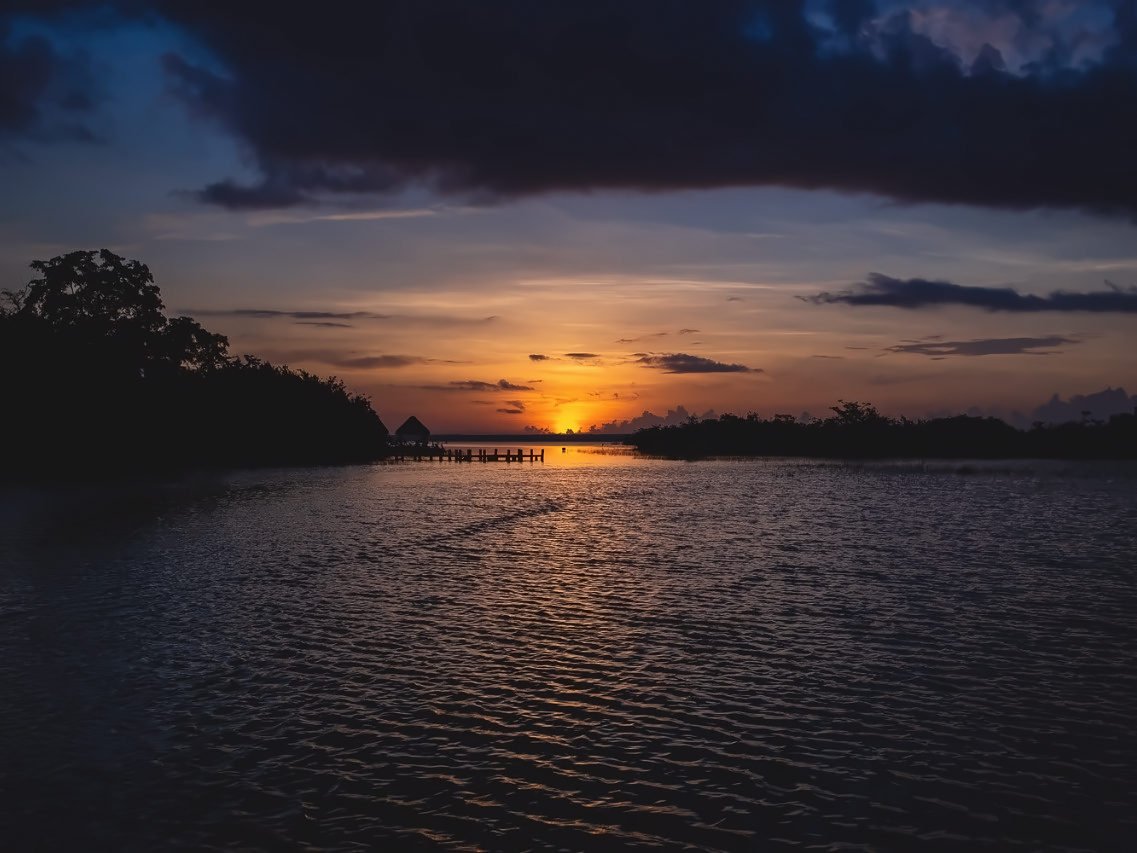
Bacalar Lagoon
The water comes from below
Bacalar's lagoon is not filled by rain or by a river. It fills from underneath, through a network of flooded caves that runs across half the peninsula. And what looks like stone along the shore is alive.
Hey Bacalar6 minute readSources at the end
I · Where it comes from
A lake that is not a lake
The ground of the Yucatán peninsula is limestone, and limestone dissolves in water. Beneath the forest there is no solid earth: there is a honeycomb of caves, shafts and rivers that run without ever surfacing. This is the Gran Acuífero Maya, Mexico's most important freshwater reserve.
The lagoon is one of the places where that system comes into the light. No river feeds it and the rain falling on it does not fill it: it is fed by cenotes and underground currents arriving from kilometres inland.
- 01Rain over the forest
- 02Seeps through the limestone
- 03Runs through underground rivers
- 04Surfaces in the cenotes and the lagoon
That explains the colour — water filtered through stone, over a floor of pale sediment — and it explains the other thing too: whatever spills or seeps into the ground anywhere on the peninsula can end up here. The lagoon has no borders downward.
II · What is along the shore
The stones that breathe
Those white and grey edges you can see from the shore, the mounds that look like porous rock, are not rock. They are stromatolites: colonies of microorganisms that build their own structure layer upon layer, over thousands of years.
They grow on the order of millimetres per decade. They are living relatives of the earliest forms of life that left a record on Earth, and Bacalar's are among the most extensive freshwater systems known.
They take a decade to grow one millimetre. They break under the weight of a person.
Cenote Azul is a case apart: it is the only cenote feeding the lagoon that is separated from it at the surface, so its stromatolites evolved in isolation. They cover the cenote walls, sometimes fifty metres down.
III · What has already happened
Not a warning. A record.
In 2020, the researcher Luisa Falcón, of the Bacterial Ecology Laboratory at UNAM's Institute of Ecology, reported that in several parts of the lagoon the surface layer of the stromatolites was already dead, with green algae taking its place.
At Los Rápidos, breakage was observed in the growing zone of the structures. At the Canal de los Piratas there was erosion and loss of mangrove and of stromatolites that had been consolidated before 2015.
The report points to two causes, and they work together: people walking on the structures, and rising ammonium, nitrate and phosphorus arriving through ground and surface water. The nutrients feed the algae, which compete and win.
IV · What is asked
What the municipal environment office recommends
This is not our list. It is the one published by the municipality's environmental authority, reproduced as it stands.
- Put your swimsuit on first and the sunscreen after. Better still, shower before going in.
- No oils or exfoliants in the lagoon.
- Do not rub the sediment from the bottom on your body or face.
- Take nothing with you: no animals, no pieces of anything.
- At Cenote Azul, do not touch the walls or the submerged trees.
- Do not walk beside the mangrove: fish spawn and birds nest there.
V · The new rules
The lagoon was divided into five zones
The lagoon did not become a Protected Natural Area: that designation was ruled out. Instead, the Chetumal–Bacalar Harbour Master's office introduced a zoning scheme with speed limits, between Bacalar and Los Rápidos.
| Zone | For what | Max. speed |
|---|---|---|
| 1 | Swimmers and small craft | 7.4 km/h |
| 2 | All vessel types, at low speed | 18.5 km/h |
| 3 and 4 | Recreational towing and jet skis, one-way traffic | 37 km/h |
| 5 | Los Rápidos and Canal de los Piratas: authorised craft only | Restricted |
Today almost every boat passes through the Canal de los Piratas, and almost every tour to Los Rápidos ends with people standing on the bottom. That is what it is.
Bacalar is glad you're here, and so is the lagoon. All it asks is that you see it for what it is: water from far away, and stones that are alive. Pick the right people to take you out on the water and you're already looking after it.
See recommended tours